How to Scale a Crypto Neobank
You’re a crypto neobank founder/CMO. The product is solid — multi-currency accounts, crypto-backed cards, seamless on/off ramps. Your team is strong. The timing feels extremely right - and it actually is.
The issue is — you’re most likely reaching only 5% of your potential users. And the reason is not what you think it is.


Welcome to a classical problem of scaling consumer web3 products
A crypto neobank is much closer to classical fintech than to a pure web3 project: it’s not a DeFi protocol, not a zk-chain, not a crosschain messaging protocol, not a token launch. It’s a consumer financial product that happens to run on crypto rails. But a lot of projects still try to avdvertise it using purely web3 methods.
Your ideal user isn’t someone who monitors CT 24/7, tracks gas fees, and debates tokenomics in Discord. Your ideal user is a 18-35-year-old who holds some ETH, hates their traditional bank, travels frequently, and wants a smarter way to manage and spend money. They’re crypto-curious, not crypto-native. Additionally, in countries with high stablecoin adoption, the target audience is even broader: it’s basically anyone who knows how to use internet and wants to ptotect their savings from inflation.
Staying inside CT means 95%+ of your potential users will never see your product — not because your marketing is bad, but because you’re simply not present where they are.
These people don’t live on 𝕏 and don’t follow lots of crypto influencers if any.
They are here:
TikTok
Instagram
YouTube
Facebook
That distinction changes everything about how you should be marketing.
The unlock: how to effectively approach these channels?
The move isn’t to abandon CT and KOLs. It’s to stop relying on them exclusively.
CT and KOL marketing should be one layer of your acquisition strategy — the layer that captures crypto-native users who are already looking for a product like yours. It’s relatively efficient for that audience and worth maintaining.
The growth layer - the one that breaks your ceiling - is reaching the mainstream crypto-curious consumer on the platforms where they actually spend time. And the most effective way to do that right now, for a product like yours, is combining organic UGC with paid ads on these platforms.
Here’s why this combination works specifically for neobanks and crypto card products:
Your product has a tangible, visual outcome. Someone tapping a crypto card at a supermarket checkout. Someone checking their multi-currency balance from a beach in Thailand. Someone converting their paycheck to crypto in 30 seconds. These moments are native to short-form video in a way that a DeFi protocol or a token launch simply isn’t. You have an inherently compelling product story - you just haven’t told it in the right format yet.
System used by the smartest web3 fintech teams
Here’s how it works:
Stage 1: Organic UGC validation
You brief 10–20 creators on your product’s core outcomes - not features, outcomes. Not “multi-currency account” but “the card that works anywhere, even where crypto isn’t supposed to.” Not “on-ramp integration” but “how I turned my salary into crypto without leaving my banking app.”
These videos go out organically on TikTok, Instagram Reels and YouTube Shorts. Less ad spend. Real audiences, real signal.
After two weeks you know - with actual data - which hooks stopped the scroll, which formats drove clicks, which angles generated saves and shares. You know what resonates with your mainstream target user before you’ve spent a dollar on distribution.
Stage 2: Paid amplification
The top-performing organic creatives enter paid media on Meta Ads and TikTok Ads. You’re not testing anymore - you’re scaling proof.
This sequencing alone cuts creative testing waste by 40–50%. Your CPA drops because you’re putting budget behind assets that already demonstrated organic pull. The learning curve accelerates because you’re iterating on proven formats, not starting from zero 0.
Stage 3: Compound and aggresively scale
Once unit economics are profitable, you scale aggressively - more creator volume, more format variations, broader targeting, higher ad spend - while keeping your CT and KOL layer running in parallel to capture the crypto-native demand that already exists.
The result is a full-funnel acquisition system: CT and KOLs capture the audience that’s already looking for you, this system builds demand with the mainstream consumer who didn’t know they needed you yet.
That’s how you break the ceiling.
The most notable example of a neobank running a similar strategy using organic content and paid ads is @RedotPay: they don’t focus on crypto native audience at all, and currenty they account for over 80% of global crypto card volume.

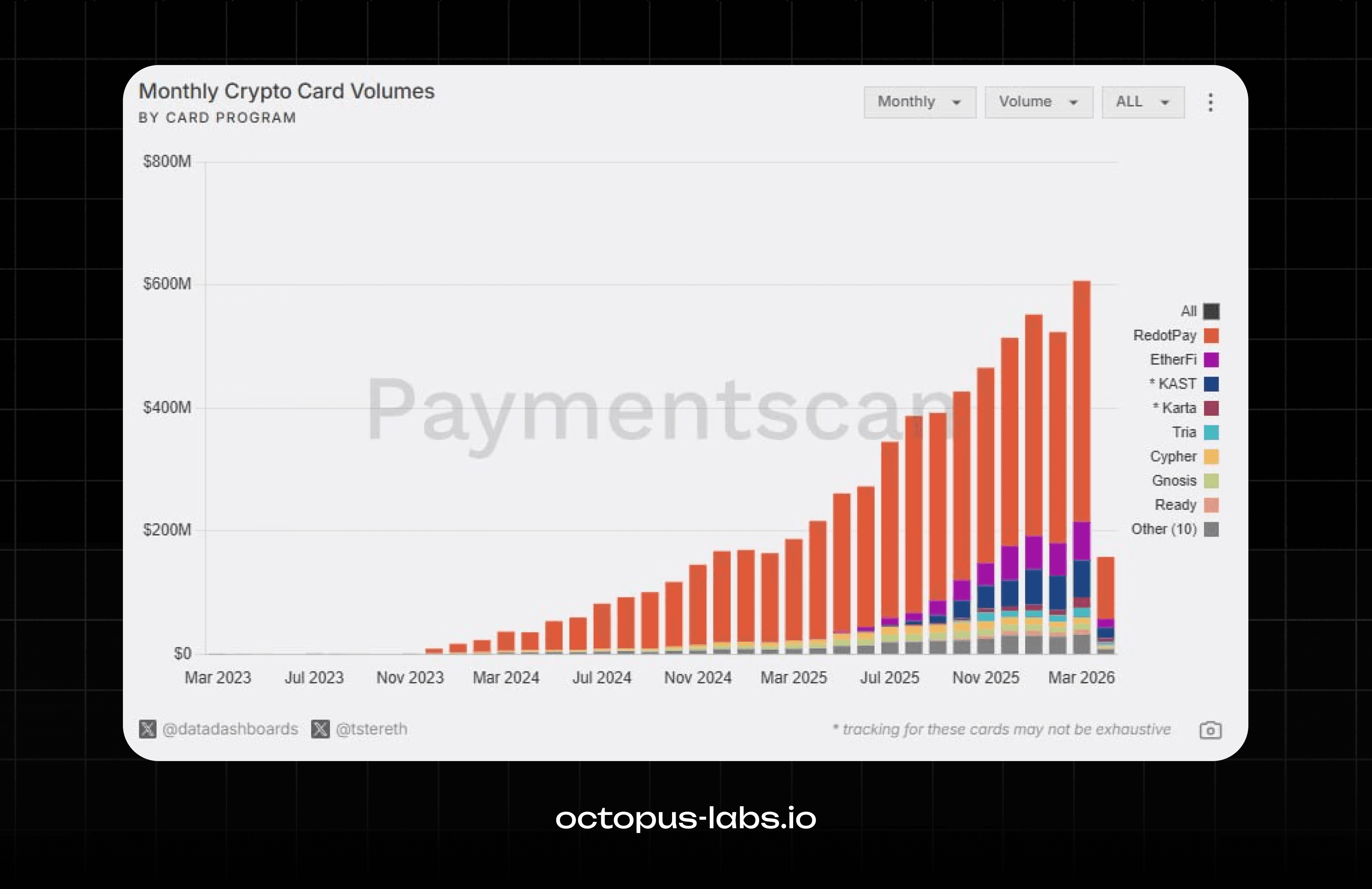
Other examples: @KASTxyz, @oobit and lots of other consumer crypto apps (not necessarilly neobanks) - Binance, Kraken, Polymarket, and a lot more.
What the next 12 months look like
CT and KOLs aren’t going anywhere - they’ll keep working for the crypto-native slice of your audience. But that slice is finite, and most serious neobanks are already reaching the ceiling of what that channel can deliver.
The teams pulling ahead right now are the ones who figured out that mainstream consumer acquisition is a different game entirely - different platforms, different creative formats, different metrics. And they started building that muscle early, before it became obvious to everyone else.
One honest note before you consider this path: it doesn’t work on a $2–3k test budget, and it won’t show its full potential in the first two weeks. Most teams who try it produce 10 creatives, see a high CPA in week one, and pull the plug before the system has had time to learn. The ones who win are the ones who commit to the full cycle - organic validation, creative iteration, then paid scale - and treat month one as infrastructure, not instant return.
If your product is genuinely built for the mainstream consumer, the audience is there. It’s just waiting to be reached.
Final thought
Crypto is supposed to become the mainstream rails for the global financial system. And neobanks are the frontend of those rails.
But if the industry never breaks out of the CT bubble, crypto will remain an instrument for a relatively narrow native audience - and the crypto neobank market will stay far smaller than it should be.
That’s what this is really about. Not just better CPA numbers.
If you’re building a crypto neobank or card product and this resonates - feel free to contact us. Happy to share what we’ve seen work for similar products and whether this system makes sense for your stage.



You’re a crypto neobank founder/CMO. The product is solid — multi-currency accounts, crypto-backed cards, seamless on/off ramps. Your team is strong. The timing feels extremely right - and it actually is.
The issue is — you’re most likely reaching only 5% of your potential users. And the reason is not what you think it is.

Welcome to a classical problem of scaling consumer web3 products
A crypto neobank is much closer to classical fintech than to a pure web3 project: it’s not a DeFi protocol, not a zk-chain, not a crosschain messaging protocol, not a token launch. It’s a consumer financial product that happens to run on crypto rails. But a lot of projects still try to avdvertise it using purely web3 methods.
Your ideal user isn’t someone who monitors CT 24/7, tracks gas fees, and debates tokenomics in Discord. Your ideal user is a 18-35-year-old who holds some ETH, hates their traditional bank, travels frequently, and wants a smarter way to manage and spend money. They’re crypto-curious, not crypto-native. Additionally, in countries with high stablecoin adoption, the target audience is even broader: it’s basically anyone who knows how to use internet and wants to ptotect their savings from inflation.
Staying inside CT means 95%+ of your potential users will never see your product — not because your marketing is bad, but because you’re simply not present where they are.
These people don’t live on 𝕏 and don’t follow lots of crypto influencers if any.
They are here:
TikTok
Instagram
YouTube
Facebook
That distinction changes everything about how you should be marketing.
The unlock: how to effectively approach these channels?
The move isn’t to abandon CT and KOLs. It’s to stop relying on them exclusively.
CT and KOL marketing should be one layer of your acquisition strategy — the layer that captures crypto-native users who are already looking for a product like yours. It’s relatively efficient for that audience and worth maintaining.
The growth layer - the one that breaks your ceiling - is reaching the mainstream crypto-curious consumer on the platforms where they actually spend time. And the most effective way to do that right now, for a product like yours, is combining organic UGC with paid ads on these platforms.
Here’s why this combination works specifically for neobanks and crypto card products:
Your product has a tangible, visual outcome. Someone tapping a crypto card at a supermarket checkout. Someone checking their multi-currency balance from a beach in Thailand. Someone converting their paycheck to crypto in 30 seconds. These moments are native to short-form video in a way that a DeFi protocol or a token launch simply isn’t. You have an inherently compelling product story - you just haven’t told it in the right format yet.
System used by the smartest web3 fintech teams
Here’s how it works:
Stage 1: Organic UGC validation
You brief 10–20 creators on your product’s core outcomes - not features, outcomes. Not “multi-currency account” but “the card that works anywhere, even where crypto isn’t supposed to.” Not “on-ramp integration” but “how I turned my salary into crypto without leaving my banking app.”
These videos go out organically on TikTok, Instagram Reels and YouTube Shorts. Less ad spend. Real audiences, real signal.
After two weeks you know - with actual data - which hooks stopped the scroll, which formats drove clicks, which angles generated saves and shares. You know what resonates with your mainstream target user before you’ve spent a dollar on distribution.
Stage 2: Paid amplification
The top-performing organic creatives enter paid media on Meta Ads and TikTok Ads. You’re not testing anymore - you’re scaling proof.
This sequencing alone cuts creative testing waste by 40–50%. Your CPA drops because you’re putting budget behind assets that already demonstrated organic pull. The learning curve accelerates because you’re iterating on proven formats, not starting from zero 0.
Stage 3: Compound and aggresively scale
Once unit economics are profitable, you scale aggressively - more creator volume, more format variations, broader targeting, higher ad spend - while keeping your CT and KOL layer running in parallel to capture the crypto-native demand that already exists.
The result is a full-funnel acquisition system: CT and KOLs capture the audience that’s already looking for you, this system builds demand with the mainstream consumer who didn’t know they needed you yet.
That’s how you break the ceiling.
The most notable example of a neobank running a similar strategy using organic content and paid ads is @RedotPay: they don’t focus on crypto native audience at all, and currenty they account for over 80% of global crypto card volume.
Other examples: @KASTxyz, @oobit and lots of other consumer crypto apps (not necessarilly neobanks) - Binance, Kraken, Polymarket, and a lot more.
What the next 12 months look like
CT and KOLs aren’t going anywhere - they’ll keep working for the crypto-native slice of your audience. But that slice is finite, and most serious neobanks are already reaching the ceiling of what that channel can deliver.
The teams pulling ahead right now are the ones who figured out that mainstream consumer acquisition is a different game entirely - different platforms, different creative formats, different metrics. And they started building that muscle early, before it became obvious to everyone else.
One honest note before you consider this path: it doesn’t work on a $2–3k test budget, and it won’t show its full potential in the first two weeks. Most teams who try it produce 10 creatives, see a high CPA in week one, and pull the plug before the system has had time to learn. The ones who win are the ones who commit to the full cycle - organic validation, creative iteration, then paid scale - and treat month one as infrastructure, not instant return.
If your product is genuinely built for the mainstream consumer, the audience is there. It’s just waiting to be reached.
Final thought
Crypto is supposed to become the mainstream rails for the global financial system. And neobanks are the frontend of those rails.
But if the industry never breaks out of the CT bubble, crypto will remain an instrument for a relatively narrow native audience - and the crypto neobank market will stay far smaller than it should be.
That’s what this is really about. Not just better CPA numbers.
If you’re building a crypto neobank or card product and this resonates - feel free to contact us. Happy to share what we’ve seen work for similar products and whether this system makes sense for your stage.


Read more


Legal

Sky Consulting
Group LLC-FZ
Legal
Sky Consulting
Group LLC-FZ

Legal
Sky Consulting
Group LLC-FZ